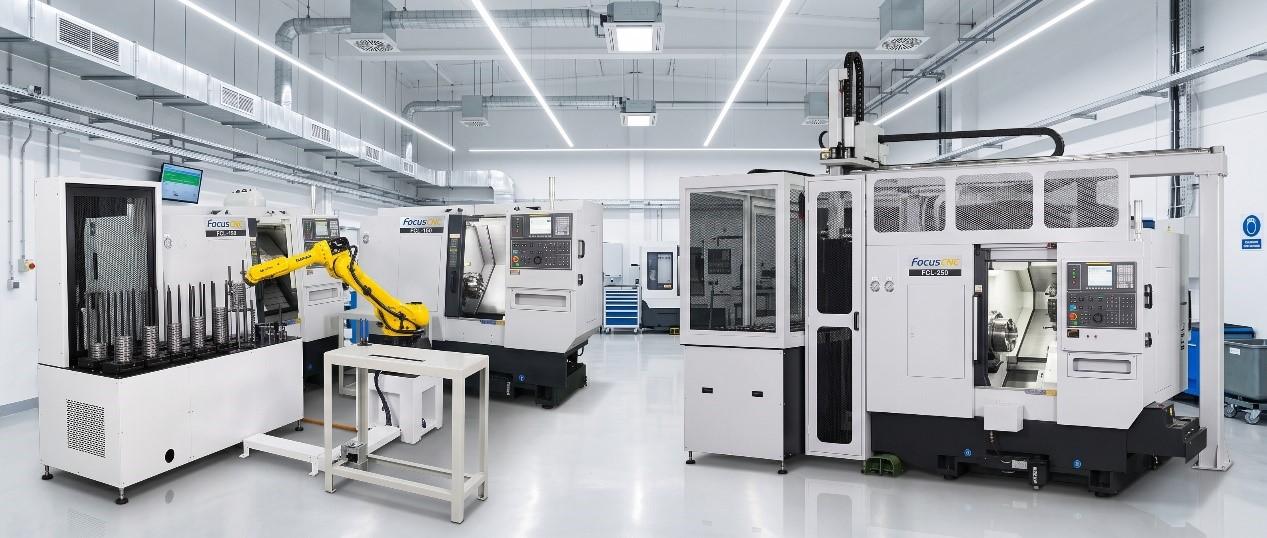
In automated CNC turning, loading and unloading the part is often the single biggest bottleneck for both throughput and labor cost. When many shops move to automation, the choice almost always comes down to two options: a gantry loader or an articulated robot arm. Both solve the problem of manual loading. But in practice, they are different in speed, rigidity, flexibility, cost, and how hard they are to integrate.
This article compares the two options based on real-world machining experience in Taiwan and actual pairings with Focus CNC lathes, so you can pick the best option that fits your production line.
Why the Type of Loader Matters
- Manual loading leads to operator fatigue, part-to-part variation, and safety risk.
- Once you move to automation, the loader has to deliver high speed, stability, and good repeatability.
- The structural differences between a gantry loader and an articulated arm have a direct effect on the efficiency and return on investment of both single-machine setup and multi-machine lines.
Focus CNC lathes are already paired with multiple gantry loaders in the field — including Auto+ gantry loaders running one-to-two automation — with a proven track record for stability and value in Taiwanese factories.
Gantry Loader vs. Articulated Robot Arm: A Practical Comparison
| Criteria |
Gantry loader |
Articulated robot arm | Practical impact |
| Structure and motion |
X-Z or X-Y-Z linear axes on a rigid frame |
Six rotating joints, mimicking a human arm | The gantry is more rigid; the articulated arm is more flexible |
| Speed and cycle time | Very fast (4 to 8 seconds per load/unload cycle) | Medium (8 to 15 seconds per load/unload cycle) | The gantry moves in a straight line with the shortest possible travel; the arm moves in curved paths and needs more clearance points along the way |
| Footprint | Mounted overhead, leaves the floor clear | Needs a dedicated safety fence around its work envelope | The gantry does not block operator access to the front of the machine; the arm takes up floor space and can block the walkway |
| Repeatability | Approximately 0.01 to 0.03 mm | Approximately 0.05 to 0.1 mm | The gantry's linear rails are rigid, so its repeatability is usually better than the accumulated positioning error across an articulated arm's multiple joints |
| Programming complexity | Simpler (linear motion commands) | More complex (requires path planning) | The gantry is faster to learn and get running |
| Return on investment | High — a mature, durable system | Medium — needs extra planning for fencing and fixtures | For production parts with a fixed shape, a gantry loader typically pays for itself fast |
Matching the Right Automation System to Your Production
Gantry loaders are the mainstream choice for loading and unloading Taiwanese CNC lathes. They are fast, rigid, and cost less, which makes them a good choice for high-volume production of parts with a fixed shape, such as shafts and tubing. Focus CNC's FBL series, paired with Auto+ gantry loaders in one-to-two automation setups, has already proven itself across multiple factories — reducing labor needs and keeping production output consistent.
Articulated robot arms are a better fit when parts have a complex shape, need to move between multiple operations, or require vision-guided picking — for example, medical parts or mixed-model production across several machines. The trade-off is slower cycle times, more complex programming, and a higher initial investment.
Practical Tips for Choosing and Setting Up Your Loader
- High volume, simple part shape: go with a gantry loader.
- Complex parts, mixed-model production across machines: consider an articulated robot arm.
- Always run an on-site test before committing — validate cycle time and part-gripping performance with your actual parts.
- Whichever loader you choose, pair it with a stabilized air or hydraulic supply to avoid gripping accuracy issues caused by pressure fluctuations.
- Check the loader's rail lubrication and gripper wear on a regular schedule to keep repeatability consistent.
Ready to make your CNC turning line truly unmanned and double your output? Contact us! We will help you find the right automation solution based on your part types and production goals — and help you put Industry 4.0 load/unload automation to work on a Focus CNC lathe.