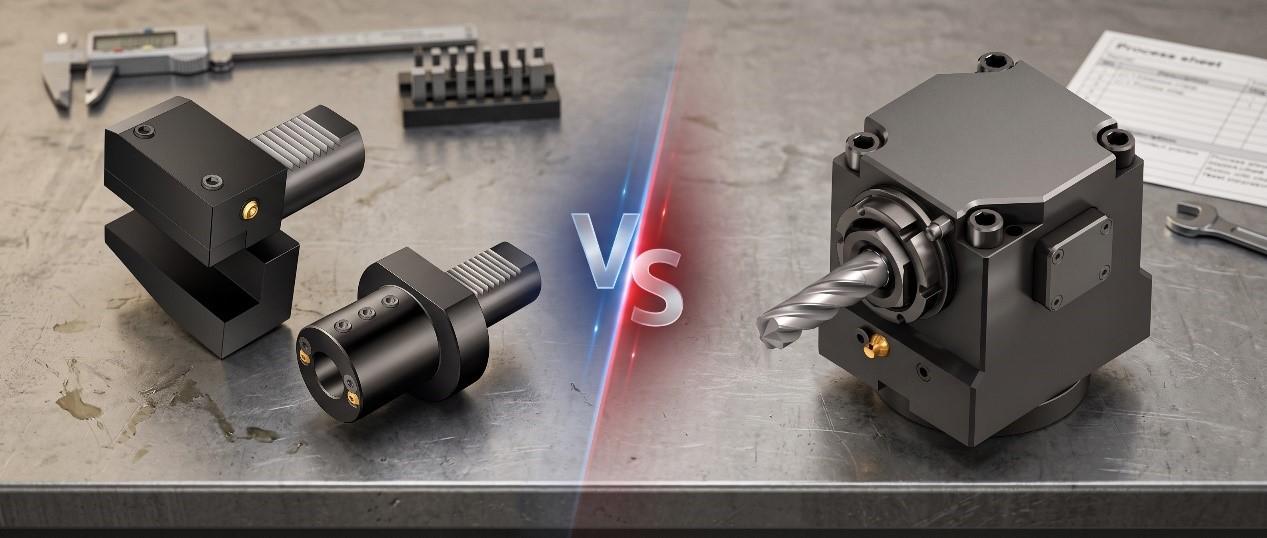
On a CNC turning machine, the power turret is one of the components that makes or breaks turn-mill performance. When some shops are choosing a power turret, the question they run into most often is simple: VDI interface or BMT interface — which one should they pick? These two interfaces are not just different mounting styles — they set the practical limits of what your machine can do when the cut gets heavy or the tolerance gets tight.
VDI: the German Standard Built for Flexibility
VDI (Verein Deutscher Ingenieure) is a quick-change standard that originated in Germany. The toolholder shank is a cylindrical post with a serrated rack machined into it; it drops into the turret station and is locked in place by an internal clamping block.
- Tool-change speed: VDI was designed from the ground up for speed. Loosen a single clamp screw and the holder pulls straight out. For high-mix, low-volume shops that are constantly swapping tooling between jobs, VDI can cut setup time significantly.
- Adjustability: VDI holders allow fine radial adjustment at installation, which makes centerline correction easy. But the same freedom is a liability after a crash: even a light collision can knock the holder out of alignment.
BMT: the Base-mount System Built for Heavy Cutting
BMT (Base Mount Tooling) is the dominant configuration on today's turn-mill machines, especially common on machines built in Taiwan and Japan. The toolholder bolts directly to the face of turret disc with four high-strength bolts.
- Rigidity: The holder base sits flat against the face of the turret disc with full contact across a large surface area. That full contact spreads the cutting force evenly through the turret body, so BMT resists vibration and torsional load really well. When you are cutting hard materials like 316 stainless or titanium, BMT usually gives you a better surface finish than VDI.
- Repeatability: BMT holders are positioned by keyways, so they stay repeatable even after you take them off and put them back on. You don't have to re-align the centerline the way you often do with VDI. This is a real advantage for dimensional stability in mass production.
Rigidity vs. Efficiency: How They Compare
| Criteria |
VDI |
BMT | Takeaway |
| Structural rigidity |
Moderate (cylindrical contact) |
Very high (flat-face contact + keyway) | BMT shows noticeably less vibration in roughing |
| Tool-change / setup time | Very fast (single-point clamp) | Longer (multiple bolts to remove/reinstall) | VDI suits fast changeovers; BMT suits stable production |
| Repeatability | ±0.01 mm | ±0.003 mm | BMT holds position with minimal physical shift after clamping |
| Crash tolerance | Holds firm (but transmits impact straight to the spindle) | BMT holds position with minimal physical shift after clamping | VDI is easier to re-align after a strike; BMT usually needs teardown and repair |
Which One Should You Choose?
- Want stable production and heavy cuts?
If you are running long production jobs, or you need deep roughing cuts, BMT is really your only choice. It is rigid enough to make your tools last longer and keep your dimensions accurate over time, so you don't have to keep adjusting the machine. - Want flexibility and fast changeovers?
If your line switches between different tools and fixtures every day, and you are mostly cutting easy materials like free-machining steel or aluminum, VDI can save you a lot of downtime.
Bottom Line
Neither one is better overall — it depends on the job. For heavy, high-rigidity work, BMT's stability is the deciding factor. For flexible, fast-changeover work, VDI's convenience is hard to beat.
Choosing a CNC Turn-Mill Machine for Your Application
When selecting a CNC turn-mill machine, the turret should be evaluated as part of the complete machining system rather than as an isolated component. A BMT turret can provide a rigid tooling platform, but machine structure, spindle specifications, axis configuration, tooling capacity, and available machining space also affect whether a machine is suitable for a particular production requirement.
Focus CNC specializes in CNC slant bed lathes and offers a range of CNC turning-milling machines for different workpiece sizes and machining requirements. Models such as the FNL-220 series use a BMT45 servo turret with live tooling, while the FBL-250Y / 320Y / SY series uses a BMT turret with four-bolt and positioning-key toolholder mounting to support stable cutting.
If you are evaluating a CNC turning-milling machine and are unsure which turret, spindle, axis, or machine configuration fits your application, contact Focus CNC with your workpiece specifications and machining requirements for further discussion.