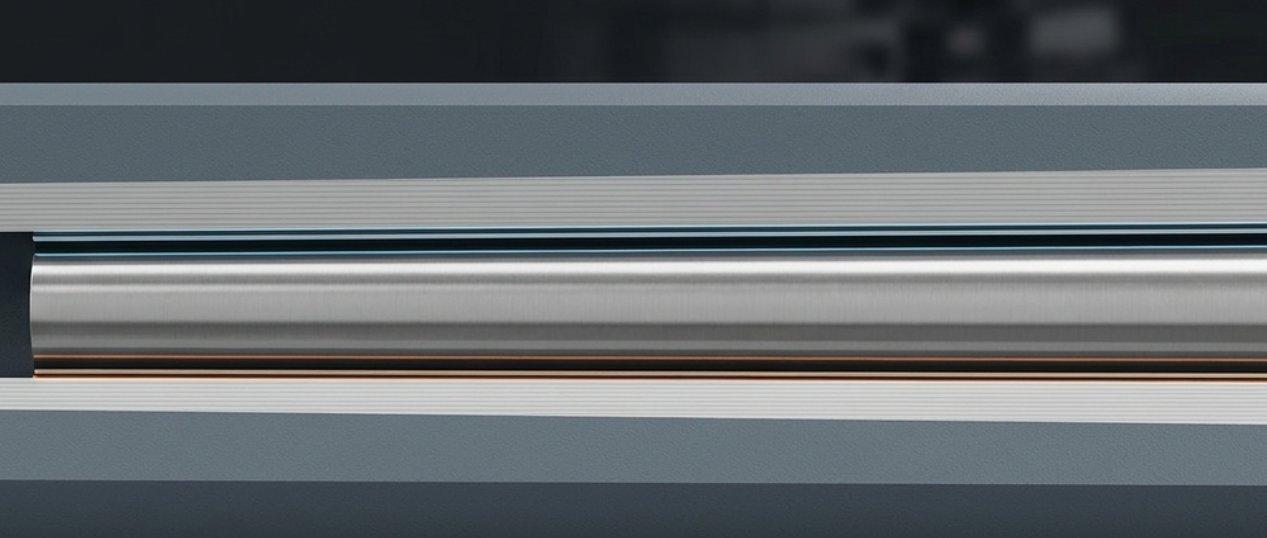
When you are planning an automated bar-fed CNC turning line, the bar feeder you choose has a direct impact on how smoothly and continuously your line runs. The problem is, a lot of people misread the spec sheet, because several terms that all sound like "hole diameter" actually mean very different things. To get bar stock passing through and spinning at high speed without vibration, you need to understand the physical structure inside the spindle, not just the numbers on paper.
The Three Numbers That Decide What Will Actually Fit
In CNC turning, there are three terms related to "bore diameter" that get confused all the time. Each one means something different for bar feeder selection.
- Spindle through-hole diameter: This is the raw bore diameter through the center of the spindle housing and bearings. It is the largest number on the spec sheet, but do not assume bar stock can pass straight through it. There are power transmission parts installed inside the spindle that take up space.
- Draw tube inner diameter: To clamp and unclamp the chuck jaws at the front of the machine, a draw tube runs through the spindle and connects to the hydraulic cylinder at the back. The inside diameter of this draw tube is the real bottleneck your bar stock has to pass through.
- Maximum bar capacity: This is usually the draw tube inner diameter minus a safety clearance. It tells you the largest raw material diameter the machine can handle with its standard setup.
When you are sizing a bar feeder or a spindle liner, always use maximum bar capacity as your baseline. Do not use spindle through-hole diameter, even though it is the bigger number.
Spindle Liners and How to Prevent Vibration
When your bar stock diameter is smaller than the machine's maximum bar capacity, the extra space inside the spindle lets the bar "whip" while it spins. That whipping causes chatter marks on the finished part and puts extra wear on the spindle bearings.
- What spindle liners do: A spindle liner is a support sleeve installed inside the draw tube. Its job is to close up the gap around the bar stock and give it steady support while it rotates.
- Getting the clearance right: In practice, the liner inner diameter should be about 1.0 mm to 1.5 mm larger than the bar diameter. That gap leaves enough room for the feed pusher to move smoothly, and it also accounts for the bar's own straightness tolerance — hot-rolled and cold-drawn bar stock is rarely perfectly straight. If the fit is too tight, the bar can jam during feeding.
- Vibration-damping materials: Good liners are usually made from polyurethane (PU) or engineering plastic. These materials absorb rotational energy, which protects the spindle bearings from early failure caused by vibration.
Installation and Setup Checks
- Center alignment. When you install the bar feeder, the center of its pusher rod needs to line up exactly with the center of the lathe spindle. Laser alignment or a taut-wire check is a good way to confirm this in practice, and keeping the alignment error within a reasonable range is the first step toward preventing feed jams and abnormal guide rail wear.
- Bar straightness. Automated production needs consistent raw material. If the bar stock has too much curvature (a good target is under 2 mm per meter), even a precision liner cannot fully compensate. At high spindle speed, a bent bar still generates strong centrifugal force, and that results in a rougher surface finish on the finished part.
- Signal handshake. Make sure the M-code signals between CNC lathe and the bar feeder — chuck confirmation, feed complete, remnant detection — are communicating correctly. Focus CNC machines offer a highly compatible control interface, so if the bar feeder reports a problem, the machine stops right away, which helps prevent a tool crash.
A bar-fed automation line only runs well when three things work together: the draw tube size on the lathe, the clearance on the spindle liner, and the push force of the bar feeder. Focus CNC does not just build a rigid machine — our technical team also works with you to spec the right liner and automation interface for your job. Contact us to get the specs right, and build a bar-fed setup that supports reliable, continuous production.