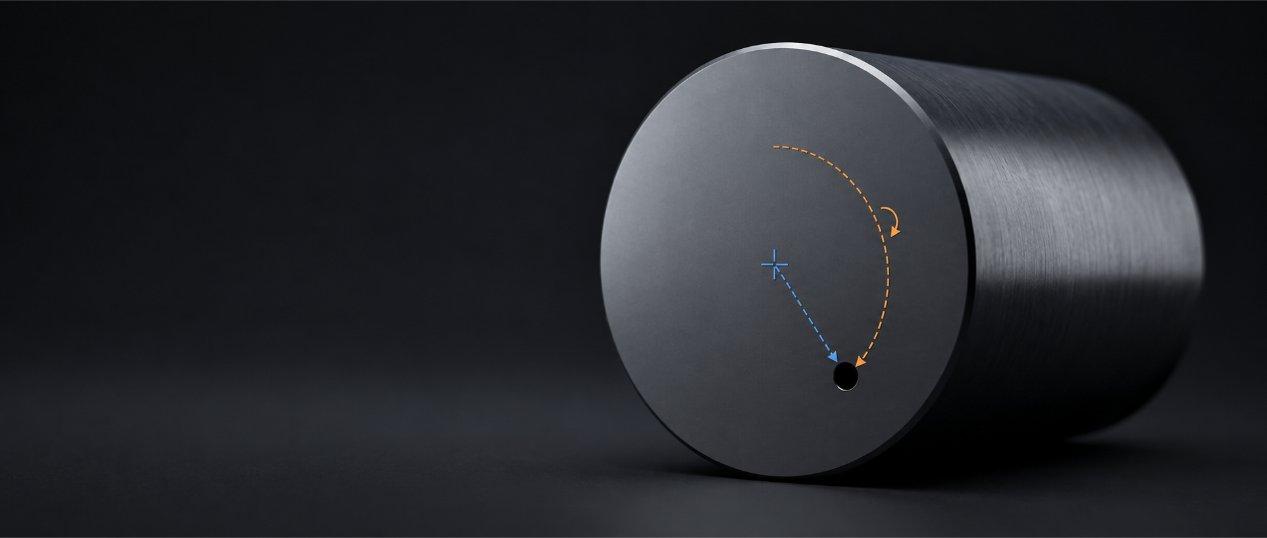
In precision parts such as aerospace valve bodies, high-pressure fluid fittings, and medical implants, off-center drilling and milling shows up all the time. In the past, you often had to unload the part from a lathe and re-chuck it on a machining center to cut these features. That extra step costs time, and every re-chuck adds a chance for geometric error.
Modern turn-mill machines solve this problem two ways: a physical Y-axis (hardware), or G12.1 polar coordinate interpolation (software). How do you decide which one to use?
Physical Y-Axis: the Most Direct and Efficient Option
If your Focus CNC machine such as the FNL-220, FBL-250 or FBL-320 series is equipped with a physical Y-axis, eccentric drilling becomes much easier.
How It Works
The turret has its own independent vertical motion axis (the Y-axis). When you need to machine an off-center hole, the main spindle (C-axis) locks in place, and the turret moves directly to the target Y-axis coordinate to drill.
Why It Is a Good Choice
- The program is intuitive. It reads almost the same as programming a 3-axis mill.
- It is the most rigid option. You can avoid the small vibrations that come from coordinated rotary-axis (C-axis) motion.
- It is the most accurate option. There is no coordinate transformation calculation involved, so there is no accumulated error.
Sample Program: Off-Center Axial Drilling (15 mm Offset)
T0707:(Tool indexing to T7 for axial live drilling)
M19
:
(Spindle orientation)
M45
:
(Switch to C-axis mode from spindle mode)
G98 S1500 M3
:
(Run the live tool at 1500RPM in CW direction)
G0 X50. Y15. Z5.
:
(Rapidly move to off-center position)
G83 Z-20. R2. Q3. F0.1
:
(Start axial drilling cycle)
G80
:
(Cancel the drilling cycle)
G0 Y0.
:
(Return the Y-axis to the center)
G12.1 Polar Coordinate Interpolation: the Answer for Machines Without a Y-Axis
If you are running a standard two-axis (X, Z) machine with live tooling but no physical Y-axis, this is where G12.1 comes in.
How It Works
This is a virtual Y-axis technique. The control performs the math in real time, coordinating the linear feed on the X-axis with the rotary feed on the C-axis. The turret cannot physically move up and down, but by combining workpiece rotation with the tool moving toward and away from the workpiece, the machine can still cut a flat face, a hex shape or an off-center profile on the end of the part.
Why It Is a Good Fit
Facing a flat surface, cutting a keyway, or handling off-center machining on a lathe that does not have a physical Y-axis.
Keep in Mind
When you are cutting a round hole with G12.1, you should use an end mill and cut it with helical interpolation or circular milling — do not use a drill. A fixed-point drilling cycle does not make sense under polar coordinate interpolation, since the whole point of G12.1 is to trace a contour, not hit a single point.
The Bottom Line: How Focus CNC Turn-Mill Machines Help
Focus CNC FNL-220Y, FBL-250Y and FBL-320Y series come with a physical Y-axis travel of up to plus or minus 55 mm. This means you will not need to reach for the more complex G12.1 conversion at all for most eccentric machining jobs.
- Long Y-axis travel. This allows you to machine off-center holes across a wider range without running into the computational limits that come with C-axis conversion.
- Multi-axis coordination. When you need to cut something more complex such as an angled hole or a three-dimensional surface, coordinating the physical Y-axis with the X, Z, and C axes together is the key to precision manufacturing.
Our recommendation: For drilling off-center holes, start with the physical Y-axis. For milling a complex face profile, turn on G12.1 polar coordinate interpolation.